The Global Power Shifts Reshaping International Relations in 2026
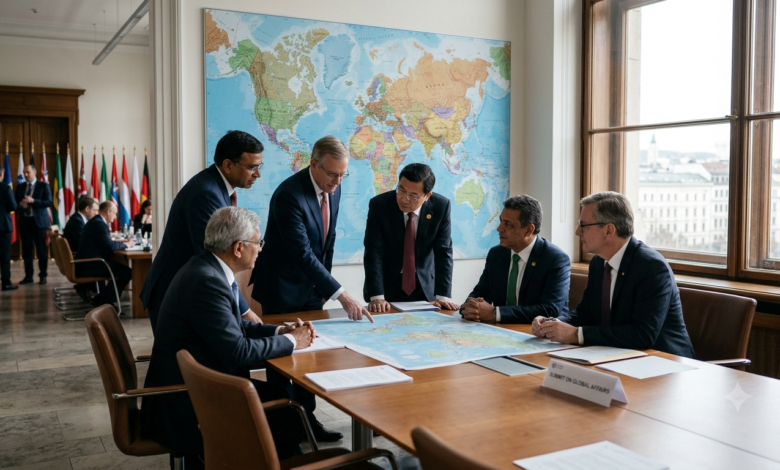
The architecture of global governance is undergoing a quiet but profound structural transformation. For decades, international relations were framed primarily around a unipolar system anchored by Western institutions, followed by a brief period of direct, bi-nodal competition between Washington and Beijing. Entering 2026, that binary framework no longer fully captures reality. Instead, global influence is becoming noticeably more distributed, transactional, and contested across overlapping spheres of power.
The year 2026 marks a decisive inflection point in this transition. Nations are actively realigning their strategic postures in response to structural shifts: economic nationalism is supplanting traditional free-trade doctrine, technological infrastructure is becoming the core currency of national security, and a broader array of regional “middle powers” is asserting significant agency.
Understanding these global power shifts in 2026 requires looking beyond isolated diplomatic headlines. This analysis explores the core structural transitions altering international diplomacy, supply chains, technology ecosystems, military strategies, and the institutional frameworks that will define the rest of this decade.
Table of Contents
The Global Balance of Power Is Changing
The defining characteristic of international relations in 2026 is the consolidation of a complex, multipolar world. Rather than dividing into rigid, Cold War-style blocs, the international system increasingly resembles a mosaic order—a flexible framework where nations maintain fluid, issue-specific partnerships based on strategic necessity.
                        ┌──────────────────────────────┐
                        │    Systemic Bipolarity       │
                        │    (U.S. vs. China)          │
                        └──────────────┬───────────────┘
                                       │
            ┌──────────────────────────┼──────────────────────────┐
            ▼                          ▼                          ▼
┌───────────────────────┐  ┌───────────────────────┐  ┌───────────────────────┐
│   Strategic Middle    │  │ Geoeconomic Alliances │  │ Global South Coalitions│
│   Powers (India,      │  │ (Critical Minerals,   │  │ (BRICS+, I2U2, ASEAN, │
│   Turkey, Brazil)     │  │ Tech Chains, Energy)  │  │ African Union)        │
└───────────────────────┘  └───────────────────────┘  └───────────────────────┘
Several macro-trends underpin this broader transition:
-
Selective Regionalization: The push for hyper-efficient, single-source global supply chains has been largely replaced by strategies prioritizing supply-chain resilience, nearshoring, and “friendshoring”.
-
Transactional Diplomacy: Multilateral consensus is increasingly giving way to targeted, plurilateral arrangements focused on specific sectors like artificial intelligence, critical minerals, or maritime security.
-
Diffused Leverage: Smaller and middle-sized states are exercising outsized leverage, leveraging their access to strategic geographical corridors or essential raw materials to secure terms from major powers.
The United States and China Remain at the Center of Strategic Competition
Despite the broadening of global power, the strategic dynamic between the United States and China remains the primary axis around which global geopolitics rotates. However, the nature of U.S.-China competition in 2026 has shifted from broad economic integration toward managed, high-stakes structural containment.
Both superpowers are balancing high-level diplomatic channels aimed at managing systemic risk against aggressive measures to secure technological and industrial independence. The U.S. continues to refine its targeted economic interventionism, using industrial subsidies, export controls, and inbound/outbound investment screening to protect strategic sectors.
Conversely, China is channeling substantial state capital into industrial overcapacity, advancing its dominance in green technologies, mature-node semiconductors, and electric transport ecosystems. This industrial expansion has created acute trade friction not only with Washington, but also with Brussels and emerging markets concerned about market distortion.
India’s Growing Role in the Global Order
India’s expanding economic footprint and strategic position have made it a pivotal player in shaping global geopolitical shifts. By maintaining a posture of “multi-alignment,” New Delhi has successfully positioned itself as a key partner for Western economies seeking supply chain alternatives, while simultaneously preserving its independent diplomatic voice within forums like BRICS and the Global South.
| Dimension | Strategic Focus in 2026 | Practical Global Impact |
| Economic | Expanding high-tech manufacturing, digital public infrastructure, and services export | Positioned as a premier alternate hub for global technology and manufacturing supply chains. |
| Diplomatic | Bridging conversations between the Global North and Global South | Serving as a critical diplomatic mediator on global trade, climate finance, and institutional reform. |
| Security | Strengthening Indo-Pacific maritime security through frameworks like the Quad | Acting as a major security provider in the Indian Ocean region while preserving strategic autonomy. |
India’s digital public infrastructure framework is being actively evaluated by developing economies as a model for financial inclusion, further expanding New Delhi’s soft power and technological influence across Africa, Southeast Asia, and Latin America.
Russia and the Future of Global Security
Russia continues to exert a disruptive influence on the international security architecture. The ongoing geopolitical confrontation between Moscow and Western nations has permanently altered European security assumptions and accelerated the militarization of regional borders.
In response to sustained Western sanctions, Russia has deepened its economic and strategic integration with non-Western economies. Moscow has reoriented its energy exports toward Asian markets and expanded political, military, and economic cooperation across parts of Africa and the Middle East. While this pivot has allowed Russia to sustain its defense-industrial base, it has also heightened its economic reliance on external markets and non-Western financial networks.
Europe’s Changing Strategic Position
The European Union is operating in an environment defined by heightened security risks, persistent economic competition, and shifting transatlantic dynamics. In response, European leaders are actively refining the concept of “open strategic autonomy”.
-
Defense Investment: European nations are significantly scaling up national defense budgets, ramping up domestic ammunition and equipment manufacturing, and hardening critical energy and telecommunications infrastructure.
-
Trade Scrutiny: Facing pressure from Chinese industrial overcapacity in sectors like electric vehicles and solar components, the EU is employing more assertive trade defense mechanisms, anti-subsidy investigations, and local-content regulations.
-
Energy Transition: Europe’s rapid phase-out of traditional pipeline dependencies has accelerated investments in renewable infrastructure, liquified natural gas (LNG) import capacity, and strategic partnerships for green hydrogen and critical raw materials.
Middle Powers and the Rise of a More Multipolar World
One of the clearest indicators that global power dynamics are evolving is the rising influence of middle powers. Nations such as Saudi Arabia, the United Arab Emirates, Turkey, Brazil, Indonesia, and South Africa are rejecting pressure to permanently align with any single major power bloc.
These countries practice a pragmatic, portfolio-based approach to foreign policy:
-
Security: Sourcing defense equipment and security partnerships from multiple global vendors to avoid single-point dependencies.
-
Finance: Engaging with Western financial systems while simultaneously utilizing local-currency trade settlement networks and cross-border digital payment rails.
-
Commerce: Securing advanced technology from Western firms while partnering with state-backed enterprises for heavy infrastructure and extraction projects.
This flexibility allows middle powers to act as indispensable brokers in global trade, energy supply, and regional diplomacy.
Technology Is Becoming a Geopolitical Battleground
The distribution of global influence in 2026 is increasingly tied to technological leadership. Artificial intelligence, advanced semiconductor manufacturing, quantum computing, and secure telecommunication networks are no longer viewed simply as commercial sectors—they are fundamental pillars of national power.
┌─────────────────────────────────────────────────────────────────┐
│                    Geopolitical Tech Stack                      │
├─────────────────────────────────────────────────────────────────┤
│  Compute Layer: Advanced Chips, Lithography, Fab Capacity       │
├─────────────────────────────────────────────────────────────────┤
│  Data Layer: Sovereign AI Models, Cross-Border Data Flows        │
├─────────────────────────────────────────────────────────────────┤
│  Infrastructure: Undersea Cables, 5G/6G Networks, Satellite     │
└─────────────────────────────────────────────────────────────────┘
To secure their advantages, major economies are combining heavy domestic capital investments with strict regulatory barriers. AI governance, data sovereignty, and technology standards have become central topics in international diplomacy. As a result, global tech supply chains are bifurcating, forcing commercial enterprises to navigate dual compliance regimes across different jurisdictions.
Trade, Energy, and Critical Resources Are Reshaping Alliances
The intersection of economic policy, resource access, and national security is reshaping global commerce. Industrial policy has returned to the forefront of economic strategy, as governments intervene directly to secure industries vital for national resilience.
Critical Mineral Coalitions
The global transition toward electrification and clean energy has shifted geopolitical attention toward critical minerals like lithium, cobalt, nickel, rare earth elements, and copper. Governments are forming targeted critical mineral alliances to secure processing capabilities and reduce reliance on single-country processing bottlenecks.
Energy Security Realignment
Global energy markets remain sensitive to geopolitical volatility. The ongoing push for energy security has driven a two-track strategy: short-term stabilization of conventional fossil fuel supply lines alongside long-term capital deployment toward renewable energy generation, nuclear power expansion, and grid modernization.
What the Changing Global Order Means for International Relations
As global power dynamics become more fragmented, traditional international institutions are facing structural pressures. Unanimous global governance through universal multilateral bodies is increasingly difficult to achieve on complex political and security issues.
In its place, international diplomacy is adapting through several mechanisms:
-
Growth of Regional Alliances: Regional groupings such as ASEAN, the African Union, and GCC are taking on greater responsibility for managing localized conflicts and driving regional economic integration.
-
Focus-Specific Coalitions: Nations are forming coalition-based frameworks to address targeted technical challenges—ranging from semiconductor supply agreements to maritime domain awareness—without requiring broad political consensus across unrelated topics.
-
Pressure for Institutional Reform: Emerging market economies are pushing for updated representation in global financial institutions like the IMF and World Bank to better reflect current economic realities.
What to Watch for Through the Rest of 2026
To understand how global power shifts in 2026 will evolve over the coming years, policy analysts and global leaders are monitoring several critical indicators:
-
High-Level Bilateral Summits: The frequency and substance of direct diplomatic engagements between major powers will test whether economic and technological friction can be managed within stable boundaries.
-
Evolving Trade Regulations: The implementation of broader border-adjustment mechanisms, supply chain traceability rules, and export controls will reveal how quickly global supply chains are re-routing.
-
Electoral Shifts in Emerging Markets: Upcoming elections across Latin America, Africa, and Southeast Asia could lead to sudden policy shifts regarding resource ownership, trade alignment, and foreign direct investment rules.
-
Pace of Technology Integration: The speed at which advanced AI tools and autonomous systems are integrated into logistics, defense, and public governance will further widen the performance gap between technologically advanced states and lagging economies.
The international system in 2026 is defined by its complexity, flexibility, and competition. Power is no longer concentrated within a single nation or a pair of competing blocs. Instead, global power shifts in 2026 have produced a multipolar world where influence depends on technological capability, resource access, economic agility, and diplomatic adaptability.
As nations navigate this altered environment, stability will depend less on restoring past frameworks and more on managing overlapping, pragmatic relationships. For governments, businesses, and international observers alike, understanding these interconnected forces is essential for navigating the evolving global order.